

Best Portable Neck Massager for Travel: 2026 Buyer's Guide
Table of Contents
- What Makes a Neck Massager Travel-Ready
- Why a Cordless Neck Massager Beats a Plug-In Model on the Road
- Portable Neck Massager With Heat: What the Setting Actually Does
- Neck Massager vs Travel Pillow: Which One Belongs in Your Carry-On
- Choosing a Travel Neck Massager for Airplane Use
- Portable Neck Massager Comparison: Specs, Pros, and Cons
- Safety, Contraindications, and Common Buying Mistakes
- Conclusion
- Frequently Asked Questions
Last Updated: October 21, 2026
What Makes a Neck Massager Travel-Ready
A travel-ready neck massager is cordless, fits inside a carry-on, runs on a rechargeable battery, and delivers enough pressure to matter after a long flight.
Most buyers focus on massage power. That's the wrong first filter. A device that hurts your neck at 30,000 feet is useless, and so is one that needs a wall socket in a hotel room you haven't reached yet.
TSA guidance on lithium batteries in carry-on luggage is worth reading before you buy anything with a built-in battery, because the rules shape which devices you can actually bring on board.
Size, Weight, and Packability
Packability is a numbers game. Check the stated dimensions and weight on the product page against the space you actually have.
- Under 250 grams: genuinely pocketable or fits in a laptop sleeve
- 250-500 grams: packable, but you'll notice it in a daypack
- Over 500 grams: a home device that travels occasionally
The NeuroRelief Neck Therapy System lists a product weight of 100 grams and dimensions of 150 × 145 × 45 mm, which puts it in the genuinely packable range. That matters because the best portable neck massager for travel is the one you don't resent carrying.

Battery, Charging, and Transit Rules
Battery life is the spec most listings handle vaguely. Treat any runtime claim without a stated test condition as marketing, not data.
Charging is where travel devices quietly fail. USB-C charging from a power bank beats a proprietary adapter you can lose in a hotel room. The NeuroRelief system charges at DC 5V over USB, so a standard travel charger or power bank works.
Why a Cordless Neck Massager Beats a Plug-In Model on the Road
Cordless wins on the road for one reason: you can use it where the tension actually happens, in a seat, on a train, in a car as a passenger, or in an airport lounge, not just next to a wall outlet.
Plug-in models are cheaper and never run out of charge, but a corded device on a flight is dead weight and in a hotel room ties you to one spot.
A cordless neck massager also changes how often you use it.
That's the real argument for cordless: frequency of use, not novelty.
Portable Neck Massager With Heat: What the Setting Actually Does
Heat on a portable neck massager with heat does one job: it relaxes surface muscle tissue so the massage feels less sharp. It doesn't treat a structural problem or replace a clinician's assessment of persistent pain.
Use heat when your neck feels tight and cold, common after air conditioning on a long flight, and on a lower intensity if your skin is sensitive. The NeuroRelief system pairs soothing heat with EMS massage technology across 6 modes and 16 intensity levels, so you can run heat with a gentle setting.

Here's what most guides miss: heat and intensity are separate dials, and the mistake is turning both up at once. Start with heat on and intensity low. Add intensity only once you know how the device feels on your neck.
Neck Massager vs Travel Pillow: Which One Belongs in Your Carry-On
A travel pillow supports your head so your neck muscles don't have to work; a neck massager works on the muscles after they've tightened. They solve different problems, and frequent flyers often want both.
| Feature | Travel Pillow | Portable Neck Massager |
|---|---|---|
| Primary job | Holds head position | Loosens tight muscles |
| When to use | During sleep or rest | Before or after sitting |
| Power needed | None | Rechargeable battery |
| Space in bag | Bulky, U-shaped | Compact, flat profile |
| Best for | Long-haul sleep | Post-flight stiffness |
If you can only bring one and your problem is stiffness rather than poor sleep posture, the massager earns its space. If you wake up with a kink after every flight, the pillow is the more direct fix.
The neck massager vs travel pillow question is really a question about your symptoms. Match the tool to the problem.
Choosing a Travel Neck Massager for Airplane Use
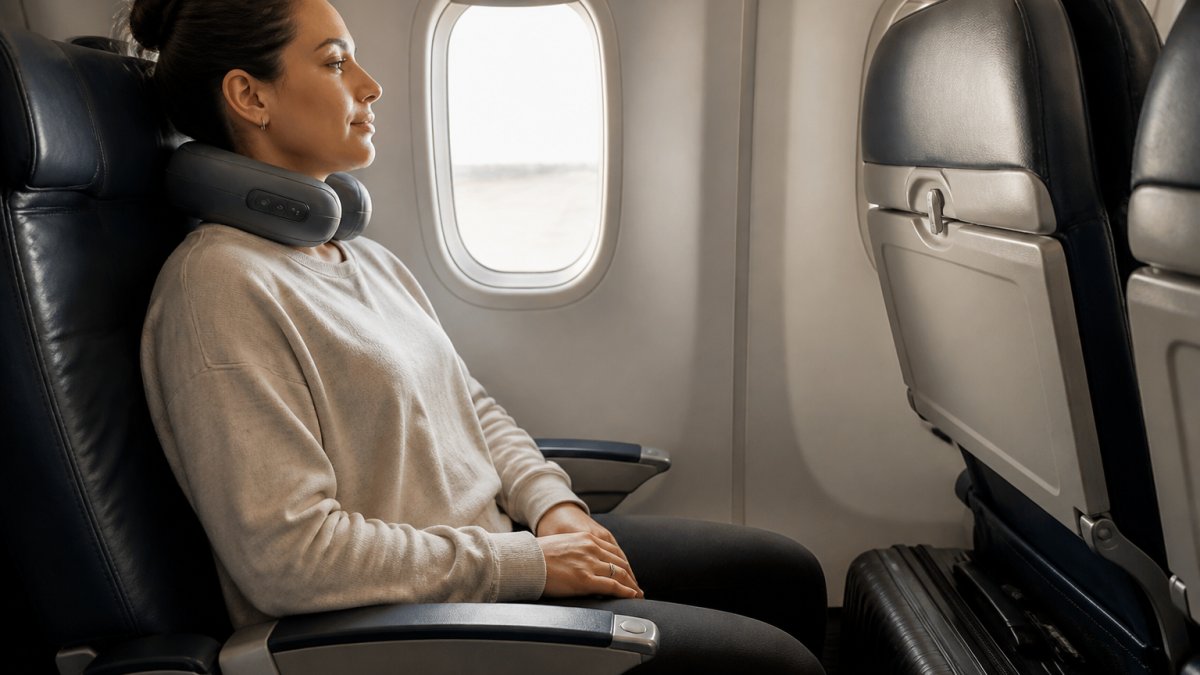
For airplane use, prioritize low noise, a secure fit that doesn't need repositioning, and a profile that doesn't invade your neighbour's space. A device that buzzes loudly or slips off mid-flight stays in the bag for the rest of the trip.
Noise, Fit, and Seat Space
Noise is the spec nobody lists. A motor you can hear over cabin hum is one your seatmate can hear too. A device below 45 dB is effectively inaudible under typical cabin noise (around 80-85 dB at cruise).
Fit matters more than most buyers expect.
Seat space is the third constraint. Anything wider than your shoulders makes economy travel unpleasant for everyone.
Relieve Neck Tension In Minutes →
Using a Massager in a Shared Cabin
Vibration from a strong motor can transmit through the seat frame, a neighbour may feel it even if they can't hear it, so choose a silicone or rubberized contact surface. Check the airline's policy on electronics during taxi, takeoff, and landing; most carriers require them stowed, so plan sessions for cruise altitude. A dangling USB cable is a tripping hazard in the aisle: use a short cable or charge before boarding.
Portable Neck Massager Comparison: Specs, Pros, and Cons
Compare devices on the specs that change your trip, not the ones that look good in a headline.
| Spec | What to Look For | Why It Matters in Transit |
|---|---|---|
| Weight | Under 250 g | Keeps your bag under airline limits |
| Dimensions | Fits a laptop sleeve | Determines whether you actually pack it |
| Charging | USB, DC 5V | Works with power banks and travel adapters |
| Runtime | Stated with test conditions | Tells you if it survives a long-haul flight |
| Timer | Auto shut-off | Prevents overuse and saves battery |
| Modes | Multiple intensity levels | Lets you start gentle on sensitive skin |
| Heat | Optional, separate control | Relaxes tissue without raising intensity |
NeuroRelief Neck Therapy System: pros and cons
Pros: 100 g weight, 150 × 145 × 45 mm footprint, USB charging at DC 5V, 6 modes, 16 intensity levels, heat therapy, 15-minute working timer, cordless design.
Cons: The 15-minute cycle is short if you want a longer session, and the compact build means it's designed for the neck rather than broad shoulder coverage.
Pricing sits at $59.00 for the standard listing and $139.00 for the fuller specification, so check which variant you're buying before you compare it to anything else. A 60-day guarantee covers the "what if it doesn't work for me" worry that stops most first-time buyers.
Safety, Contraindications, and Common Buying Mistakes
Safety comes down to knowing when not to use a device. EMS and heat are generally well tolerated but aren't right for everyone, and no product page should be your only source of advice.
Who Should Avoid EMS and Heat
Speak to a clinician before use if you have a pacemaker or other implanted electronic device, are pregnant, have a skin condition on the neck, or have neck pain following an injury.
The mechanism: EMS sends low-level electrical impulses that trigger muscle contractions, which can interfere with implanted devices like pacemakers or insulin pumps even at low intensity.
A practical rule: if you have any medical condition affecting the neck, heart, or nervous system, treat the massager as a comfort tool, not a treatment.
Heat and Pressure: Safe Limits
Heat and intensity are separate dials; don't turn both up at once. Start with heat on and intensity low, and add intensity only once you know how the device feels.
Pressure is another variable. More pressure isn't better; it can compress nerves or blood vessels if applied too aggressively. If you feel throbbing, dizziness, or a headache during use, stop immediately. These are signs the device is pressing on a sensitive structure, not signs of "deep tissue work."
Common Buying Mistakes
The most common buying mistakes:
- Buying on intensity claims alone. Higher intensity isn't better if you can't tolerate it. Look for fine-grained control (16 levels is better than 3) so you can start low.
- Ignoring the timer. A 15-minute auto shut-off is a safety feature, not a limitation. Devices without a timer invite overuse.
- Skipping the return policy. Check the guarantee before you order, especially online. A 60-day guarantee (like NeuroRelief's) lets you test the device on a trip without risk.
- Expecting a cure. These devices support relaxation and recovery. They don't diagnose or treat a medical condition.
- Overlooking battery safety. Lithium-ion batteries in cheap devices can swell or overheat. Buy from brands that specify battery capacity and charging voltage, and never charge a device unattended on a plane.
If massagers have hurt or felt superficial before, the fix is usually fine-grained intensity control rather than more power. Start low, use heat, and build up.
Never use an EMS device while driving or operating machinery. The muscle contractions can be distracting, and the device may shift unexpectedly.
Conclusion
Travel neck tension is a routine problem with a routine fix, and the device that helps is the one small enough to actually carry. Get NeuroRelief built the NeuroRelief Neck Therapy System around that constraint: cordless design, 100 g weight, USB charging, 6 massage modes, 16 intensity levels, and soothing heat therapy for a 15-minute daily relief routine. It comes with a 60-day guarantee, so you can test it on your next trip without the risk. Add one to your cart before your next flight and give your neck a routine it can rely on.
Frequently Asked Questions
Is a neck massager allowed on a flight?
Yes. Cordless neck massagers with built-in lithium batteries can generally be carried in your hand luggage, but most airlines require spare batteries to stay in the cabin rather than checked bags. Check your airline's battery rules before you fly, keep the device switched off during taxi and takeoff, and confirm the battery capacity is within the carrier's limit. A compact unit like the NeuroRelief Neck Therapy System, which charges by USB and weighs 100 g, is easier to declare and stow than a bulky plug-in model.
Should I choose a heated neck massager or a massage-only model for travel?
Heat adds a relaxation benefit that massage alone does not, and it helps loosen tight neck and shoulder muscles before deeper kneading begins. For travel, look for optional heat you can switch off, since some people find warmth too intense in a warm cabin or on sensitive skin. A portable neck massager with heat and adjustable intensity lets you start low and build up. If you only want pressure relief and want to save battery, a massage-only setting is the lighter option.
Are portable neck massagers safe to use every day?
Most cordless neck massagers are designed for short daily sessions, typically around 15 minutes, and include an auto shut-off to prevent overuse. Start on the lowest intensity, especially if you have sensitive skin or a low heat tolerance. Skip the device on areas with broken skin, and check with a doctor first if you have a neck injury, a pacemaker, or circulation problems, since EMS and heat are not appropriate for everyone.
How do I pack and clean a portable neck massager?
Let the device cool, wipe the contact surfaces with a slightly damp cloth, and dry it fully before packing. Keep it in a padded pouch or the original box so the massage nodes and heat plate are not crushed against hard items in your carry-on. Charge it to roughly half capacity before a trip, pack the USB cable separately, and keep the unit in your cabin bag if it has a built-in battery. Never submerge a cordless neck massager in water.