

Why Do Massagers Feel Painful? Causes and Fixes
Table of Contents
- Why Do Massagers Feel Painful? The Short Answer
- When a Neck Massager Hurts: Normal Soreness vs. a Warning Sign
- How Neck Massager Pressure Settings Change the Experience
- Why One Spot Hurts More Than the Rest of Your Neck
- How Long to Use a Neck Massager Without Causing Pain
- Massage Safety Precautions Before You Switch It On
- Choosing a Massager That Won't Hurt: What to Look For
- Frequently Asked Questions
Last Updated: October 14, 2026
Why Do Massagers Feel Painful? The Short Answer
Why do massagers feel painful? Most of the time, it comes down to too much pressure, too high an intensity setting, or a device that digs into one spot for too long. The good news: discomfort is usually adjustable, not a sign the device is broken.
Your neck is packed with small muscles, nerves, and joints. They respond to force in different ways. A gentle kneading motion can help tight muscles relax. A hard, fast pulse on the same spot can make them tighten instead.
Below, we break down what normal soreness feels like, when to stop, and how to pick settings that actually help.
When a Neck Massager Hurts: Normal Soreness vs. a Warning Sign
Mild soreness after a massage is common and usually fades within a day. Sharp pain during use is not normal. That difference matters more than anything else .
The Cleveland Clinic guide to muscle soreness explains that soreness after physical pressure on muscles is a normal tissue response. It often feels like a dull ache, not a stabbing sensation.
What Post-Massage Soreness Looks Like
- Dull, spread-out ache rather than a sharp point
- Feels tender when you press the area
- Eases within 24 to 48 hours
- No numbness, tingling, or weakness
Red Flags That Mean Stop Now
- Sharp, shooting, or electric pain
- Numbness or tingling down your arm
- Dizziness, nausea, or a headache that gets worse
- Pain that lasts more than two or three days
If any of these show up, stop using the device and talk to a doctor. That is not a pressure problem. It may be a nerve or circulation issue that needs a real diagnosis.
How Neck Massager Pressure Settings Change the Experience
Pressure settings are the single biggest factor in whether a neck massager hurts. But not all pressure feels the same, because different device types deliver force in different ways. Understanding the mechanism helps you choose a setting that relaxes muscle instead of guarding it.
EMS and TENS devices send small electrical pulses that trigger muscle contractions. Higher intensity means stronger contractions. On a sensitive neck, that can cross from helpful into too much very quickly. The sensation should feel like a gentle tapping or buzzing, never like a muscle cramp or a shock.
Kneading and shiatsu massagers use rotating nodes to mimic thumb pressure. The risk here is sustained pressure on one spot. Even at a low intensity, holding a node against a trigger point for more than a minute can leave you sore.
Percussion massagers and massage guns deliver rapid pulses. Speed and amplitude matter more than raw force. A high speed on a bony area or the front of the neck can irritate nerves even if the pressure feels light.
A practical pain scale for any device:
- 0-2 (comfortable): You can breathe normally, your shoulders stay relaxed, and you could hold a conversation.
- 3-4 (therapeutic but noticeable): A firm, spreading sensation. You feel the muscle being worked, but you are not tensing up.
- 5-6 (too much): You catch yourself holding your breath, clenching your jaw, or pulling away. Turn the intensity down one or two levels.
- 7-10 (stop): Sharp, shooting, electric, or numbing pain. Stop immediately and do not resume that session.
A simple rule: if you have to tense up or hold your breath, the setting is too high. Most people find their comfortable level two or three steps below the maximum, not at the top.
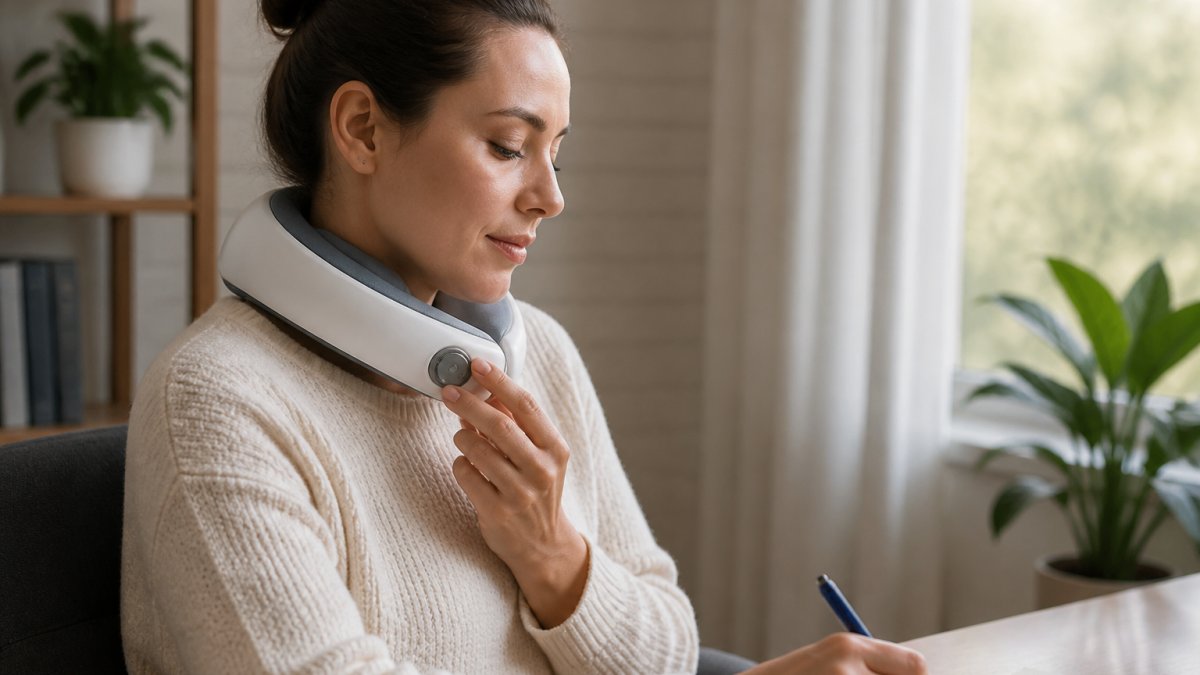
For at-home devices, follow the manufacturer's instructions for placement and duration. The FDA notes that EMS-style devices should not be used on the head, over the heart, or across the front of the neck. If your device has a timer, use it. If it does not, set a phone alarm for 10 to 15 minutes.
Why One Spot Hurts More Than the Rest of Your Neck
A massager often hurts in one specific spot because that area is already irritated. Trigger points, tight muscle bands, and overused tissue react more strongly to pressure than the surrounding muscle.
Trigger points are small, tight knots in muscle fibers that feel tender when pressed. They are common in the upper neck and shoulders, especially after long hours at a screen.
When a device presses on a trigger point, the muscle may tighten instead of relax. That is a protective reflex, not a sign you need more force.
What most guides miss is this: the sore spot is often not the source. Tension in your shoulders can pull on your neck and make one small area feel raw.
- Move the device slowly instead of holding it in place
- Spend less time on the tender spot, not more
- Work the surrounding muscles first to loosen things up
How Long to Use a Neck Massager Without Causing Pain
Most neck massagers should be used for 10 to 15 minutes per session. Going longer does not add benefit. It usually adds soreness.
The NeuroRelief Neck Therapy System has a built-in 15-minute timer. Short, regular sessions can be more effective than one long session.
Relieve Neck Tension In Minutes →

For daily use, one or two short sessions work well for most people. If your neck feels tender the next day, cut back to one session or drop the intensity.
How long to use a neck massager also depends on your goal:
- Quick reset during a work break: 5 to 10 minutes
- End-of-day wind-down: 15 minutes
- After a long flight or drive: 15 minutes, then rest
Massage Safety Precautions Before You Switch It On
Massage safety precautions matter most for people with certain health conditions. A neck massager is not right for everyone, and that is worth knowing before you buy one. But safety is not just a checklist of who should avoid massage. It is also about knowing when to stop, when to adjust, and when to seek medical advice.
Skip neck massage devices, or check with a doctor first, if you:
- Have a pacemaker or another implanted electronic device
- Are pregnant
- Have a history of blood clots, nerve damage, or a recent injury
- Have thin, damaged, or bruised skin in the treatment area
- Recently had surgery on your neck or spine
- Take blood-thinning medication
- Have reduced sensation in the neck or shoulders (for example, from diabetes or neuropathy)
The U.S. Food and Drug Administration advice on electrical stimulation devices notes that EMS-style devices should not be used on the head, over the heart, or across the front of the neck. Follow the device manual for placement.
Device-specific safe-use instructions:
- Start at the lowest intensity and shortest duration. You can always add more, but you cannot undo a session that was too strong.
- Avoid bony areas such as the base of the skull, the spine, and the collarbone. Pressure there can irritate nerves and blood vessels.
- Never use a massager on the front of the neck, where the carotid arteries and windpipe are located.
- Keep sessions to 10 to 15 minutes per area. Longer is not better and can leave muscles inflamed.
- Do not use a device while driving or sleeping.
- Keep the skin dry and free of lotions before use.
- Check for frayed cords or damaged pads before each session.
- Stop at the first sign of skin irritation, numbness, or tingling.
When to stop and seek medical advice:
- Pain that is sharp, shooting, or electric
- Numbness, tingling, or weakness in your arm or hand
- Dizziness, nausea, or a headache that gets worse
- Pain that lasts more than two or three days
- Swelling, bruising, or skin changes that do not improve
If any of these show up, stop using the device and talk to a doctor. That is not a pressure problem. It may be a nerve or circulation issue that needs a real diagnosis.
A few habits keep sessions safe: never use a device while driving or sleeping, keep the skin dry and free of lotions before use, check for frayed cords or damaged pads, and stop at the first sign of skin irritation.
Choosing a Massager That Won't Hurt: What to Look For
The right device gives you control. If you cannot dial the intensity down to a gentle level, you will not use it. That is the real test.
Here is what separates a comfortable device from a painful one:
| Feature | Why It Matters | What to Avoid |
|---|---|---|
| Adjustable intensity | Lets you start low and build up | On/off only, no levels |
| Auto shut-off timer | Prevents overuse and soreness | No timer at all |
| Multiple modes | Matches pressure to the area | One fixed pulse pattern |
| Heat option | Helps tissue relax first | Heat that cannot be turned off |
| Cordless design | Easy to use anywhere | Cords that limit position |
The NeuroRelief Neck Therapy System offers 16 adjustable intensity levels, 6 massage modes, soothing heat, and a cordless build. This range allows users to find a setting that helps instead of hurts.

If you have had bad luck with other neck massagers, the issue was likely the settings, not the idea. A device with real control changes the experience.
Frequently Asked Questions
Why does my massager hurt instead of feel relaxing?
Painful massagers usually come down to three things: too much pressure, too long a session, or a technique that doesn't suit the area. Deep tissue work can trigger a temporary inflammatory response, so a massager on a high setting over tight muscles often feels sharp rather than soothing. Drop the intensity, shorten the session to around 10 to 15 minutes, and move slowly rather than holding one spot. If pain continues on the lowest setting, stop and check whether the area is inflamed or injured.
How much pressure should I use with a neck massager?
Start on the lowest neck massager pressure setting and build up only if the sensation stays comfortable. A useful rule is to stay under a 4 out of 10 on a pain scale, where 0 is nothing and 10 is unbearable. You should feel firm contact and warmth, not sharpness or numbness. If you have to tense your shoulders or hold your breath, the pressure is too high. Adjust intensity before you adjust session length.
Can a massager make you sore afterward?
Yes. Temporary soreness after a massage is common and typically fades within 24 to 48 hours. It happens because sustained pressure and kneading cause micro-changes in muscle fibers, which triggers a mild inflammatory response. The soreness should feel like post-workout stiffness, not stabbing or burning pain. If soreness lasts longer than two days, gets worse, or comes with swelling, bruising, or restricted movement, that points to something beyond normal recovery and deserves a medical opinion.
When should I stop using a massager?
Stop immediately if you feel sharp pain, numbness, tingling down the arm, dizziness, or a headache that builds during use. These are not signs of a good massage. Also stop if the area is hot, swollen, bruised, or if you have an untreated injury, a skin infection, or a condition like deep vein thrombosis. Massage safety precautions apply to everyone, but they matter more if you are pregnant, recovering from surgery, or managing a chronic condition.
Neck tension should not be something you just live with, and it should not take a painful gadget to fix. At Get NeuroRelief, we built the NeuroRelief Neck Therapy System with 16 intensity levels, 6 massage modes, and soothing heat so you can dial in comfort instead of bracing through it. It is cordless, runs on a 15-minute timer, and comes with a 60-day guarantee. Get started with Get NeuroRelief and turn a few minutes a day into real neck relief.