

Why Does My Neck Hurt After Work? Relief & Prevention
Table of Contents
- Why Your Neck Hurts After Work: The 5 Most Common Causes
- Neck Pain at Work: How Your Daily Tasks Load Your Neck and Shoulders
- Desk Ergonomics for Neck Pain: A Step-by-Step Workstation Adjustment Guide
- Stiff Neck After Sitting: Why It Happens and How to Loosen It
- How to Ease Neck Pain at Work: Breaks, Stretching, and Movement
- Prevention Plans for Different Kinds of Work
- Self-Care vs. Urgent Care: When Neck Pain Needs a Doctor
- Conclusion
- Frequently Asked Questions
Last Updated: October 19, 2026
Why Your Neck Hurts After Work: The 5 Most Common Causes
If you're wondering why does my neck hurt after work, the short answer is load. Your neck supports a 10 to 12 pound head in neutral; tilt it forward and the effective load climbs, about 10 pounds per inch of forward drift.
Your neck muscles hold your head in place for hours. When that position drifts forward, or tasks repeat the same motion, the muscles, joints, and nerves take the strain. Here are the five causes we see most often.
1. Forward Head Position and Screen Use
Every centimeter your head drifts forward adds load to your neck muscles.
A laptop on a desk forces a compromise: the screen sits too low, so you drop your head, or the keyboard sits too high, so you raise your shoulders.
The fix: bring the screen to your eyes, not your eyes to the screen. Most people never adjust monitor height, that's the first thing to change.
2. Muscle Strain and Overuse from Repetitive Movements
Muscle strain is damage to muscle fibers from holding or repeating a position too long. Office work rarely involves lifting, so people dismiss it. But holding a phone to your ear or typing with raised shoulders all count as overuse.
The result is muscle tension that builds through the day and shows up as a stiff neck by evening, a cervical strain in slow motion.
3. Nerve Pressure and Pinched Nerves
A pinched nerve in the neck happens when a nerve root gets compressed by a disc, bone, or tight muscle. The pain often travels into the shoulder or arm, with numbness, tingling, or weakness rather than just a sore neck.
This cause needs more caution than simple strain. If pain radiates down your arm, get it checked. The NHS guide to neck pain and cervical radiculopathy explains when arm symptoms need a medical review.
4. Sudden Injuries and Awkward Lifting
Not all work neck pain builds slowly. A fall, a rear-end collision while driving for work, or lifting a heavy box with a jerking motion can strain the neck in a single moment.
Sudden onset pain after an injury is different from the end-of-day ache. If the pain started with a specific event, treat it as an injury first, see the self-care versus urgent-care section below before you try stretching or massage.
5. Age-Related Changes and Desk Posture Combined
Discs in the neck lose hydration and height with age, and joints develop wear. Pain isn't inevitable, but the same workstation that felt fine at 25 can produce symptoms at 45, age-related changes lower your margin for error, so the forward head position you tolerated for years starts to hurt.
This is why two coworkers with identical desks can have different symptoms. The load is the same; the tissue's tolerance is not.
What Your Pain Pattern Is Telling You
Before you pick a fix, match your symptoms to the likely trigger:
- Pain builds through the day and eases with movement, likely posture and static load. Start with the ergonomics section.
- Pain is sharp with specific repeated motions, likely overuse strain. Look at task rotation and microbreaks.
- Pain radiates into the arm with tingling or weakness, possible nerve involvement. Get it checked before self-treating.
Timing and location point to the trigger more reliably than intensity: a mild ache that appears at the same time every workday is a stronger clue than a severe ache that comes and goes randomly.
Neck Pain at Work: How Your Daily Tasks Load Your Neck and Shoulders
Your work tasks decide where the load lands. Desk work loads the neck and shoulder muscles through static holding; manual labor loads them through repetition and force. Both end in work-related pain by the end of the shift.
Three loading patterns cover most jobs:
- Prolonged sitting with a fixed head position and long screen use
- Repetitive movements like scanning, packing, or assembly
- Overhead work such as shelving, painting, or installation
Each stresses the neck and shoulder muscles differently, so a single generic fix rarely works. Match your relief plan to your actual job.
Desk Ergonomics for Neck Pain: A Step-by-Step Workstation Adjustment Guide
Desk ergonomics for neck pain starts with one rule: set the chair, then the screen, then the input devices. Most people do it in the wrong order and end up slouched again within a week. Follow these steps in sequence.
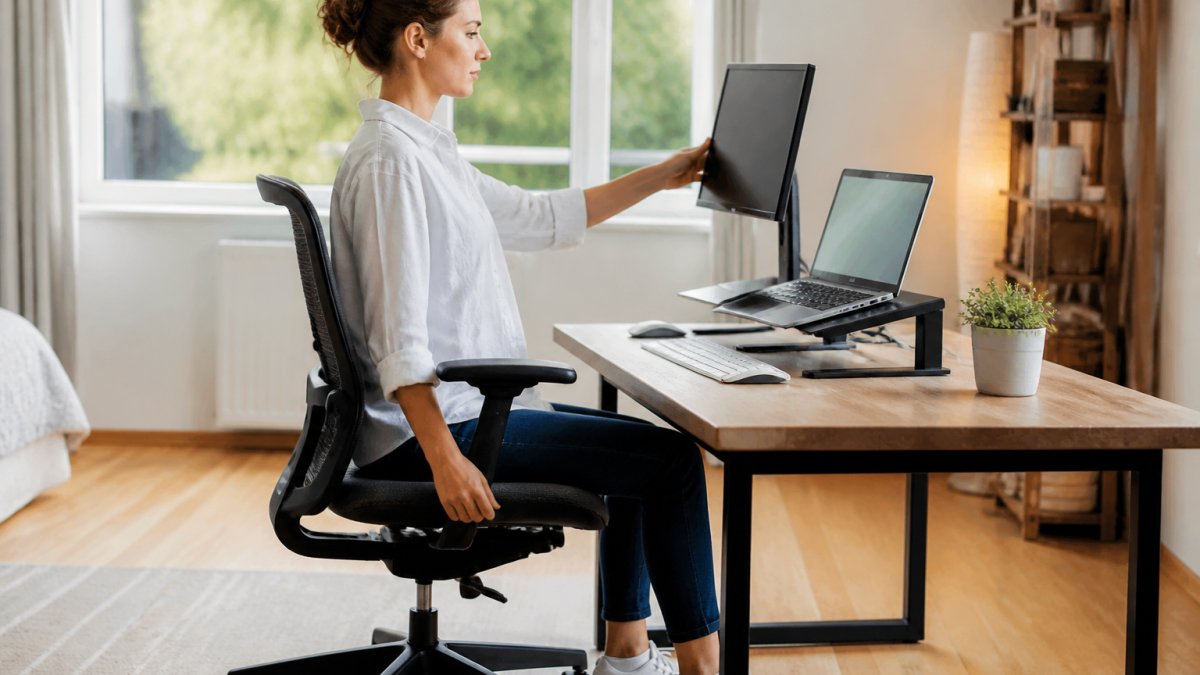
- Set chair height so feet rest flat and knees sit at hip level.
- Adjust the backrest to support your lower back, not just your shoulders.
- Raise the monitor so the top of the screen sits at eye level.
- Move the screen closer. Arm's length is a good starting point.
- Lower your keyboard so elbows rest near 90 degrees.
- Check your head position in a side mirror or phone photo.
That last step matters. Most people think their working posture is fine until they see a photo of it. Take one today.
Stiff Neck After Sitting: Why It Happens and How to Loosen It
A stiff neck after sitting comes from stillness. Hold one position for hours and blood flow around the neck muscles slows, and the tissues stiffen. The pain and stiffness at 4 p.m. is your neck asking for movement, not rest.
Relieve Neck Tension In Minutes →
Loosen it with gentle motion, not force:
- Turn your head slowly left and right, 5 reps each side
- Tilt ear to shoulder, hold 15 seconds, switch sides
- Roll shoulders back in slow circles, 10 reps
Skip aggressive stretching into pain. If a movement sends pain down your arm, stop. The Cleveland Clinic overview of neck pain notes that gentle movement usually helps stiffness more than bed rest.
How to Ease Neck Pain at Work: Breaks, Stretching, and Movement
How to ease neck pain at work comes down to frequency, not duration. Short movement breaks beat one long stretch session. Set a timer for every 30 to 45 minutes and do one of these:
- Stretching the upper neck and shoulders for 30 seconds
- Standing up and rolling your shoulders
- A 60-second walk to refill your water
Posture correction works the same way. You can't hold perfect posture all day, and you don't need to. Change position often: a movement break at least once an hour and a longer walk at lunch.
For deeper tension at the end of the day, a targeted device helps. The NeuroRelief Neck Therapy System combines EMS massage with soothing heat, and it's cordless, so you can use it at your desk or on the couch.


Prevention Plans for Different Kinds of Work
Prevention isn't one plan. It's four, and you pick the one that matches your job. The table below gives the main risk and the daily habit that matters most for each type of work; the sections after it explain how to build the habit into a real shift.
| Work Type | Main Risk | Daily Prevention Habit |
|---|---|---|
| Desk and screen work | Forward head position, prolonged sitting | Raise monitor, break every 45 minutes |
| Manual labor and lifting | Repetitive strain, sudden injury | Warm up, vary tasks, lift with legs |
| Overhead work | Shoulder and neck overuse | Rotate tasks, rest arms below shoulder height |
| Driving and travel | Fixed head position, long sitting | Adjust headrest, stretch at every stop |
Desk and Screen Work
Desk work loads the neck through static holding, so prevention means changing position often, not finding one perfect posture.
- Set a movement timer for every 45 minutes. Stand, roll your shoulders, and walk for 60 seconds.
- Use the 20-20-20 rule for your eyes as a neck break in disguise: every 20 minutes, look at something 20 feet away for 20 seconds. It pulls your head out of the forward position.
- Rotate between sitting and standing if you have a sit-stand desk. Alternate roughly every 30 to 45 minutes rather than standing all day.
Manual Labor and Lifting
Manual work loads the neck through repetition and force, so prevention means warming up before the shift and varying tasks when you can.
- Warm up for 3 to 5 minutes before heavy work, shoulder rolls, gentle neck turns, and a short walk.
- Lift with your legs and keep the load close to your body. Avoid jerking motions, especially with overhead or twisted lifts.
- Rotate tasks every hour or so when possible, alternate lifting, carrying, and fine-detail work.
Overhead Work
Overhead work, shelving, painting, installation, stocking, keeps arms above shoulder height and the neck extended. Prevention means limiting continuous overhead time.
- Rotate tasks so overhead work is broken up by work at chest or waist height.
- Rest your arms below shoulder height every 15 to 20 minutes during long overhead stretches.
- Use a step stool or lift to bring the work closer to eye level rather than reaching up.
Driving and Travel
Driving and travel load the neck through a fixed head position and long sitting, often with road vibration.
- Adjust the headrest so the top sits at about ear level and close to the back of your head.
- Move the seat so you can comfortably reach the wheel without leaning forward.
- Stretch at every stop, gentle neck turns and shoulder rolls take under a minute.
For travelers, the cordless design of the NeuroRelief system makes it easy to pack. Use it after a long flight to relax tight neck muscles before sleep.
Self-Care vs. Urgent Care: When Neck Pain Needs a Doctor
Most work-related neck pain responds to self-care within a few days. Rest, gentle movement, heat, and better workstation ergonomics usually ease muscle soreness. But some symptoms need a medical evaluation without delay.
Seek urgent care if you notice:
- Severe neck pain after an injury or fall
- Numbness or weakness in an arm or hand
- Pain with fever, confusion, or a severe headache
One rare but serious cause is cervical artery dissection, where a blood vessel in the neck tears. The NHS information on neck pain red flags lists the warning signs, and sudden severe pain with neurological symptoms should always be checked.
Conclusion
Recurring neck pain after work is a signal, not a life sentence. Fix the load, add movement breaks, and give tight muscles a daily recovery routine. That's where Get NeuroRelief fits: our cordless system pairs EMS massage with soothing heat, offers 6 modes and 16 intensity levels, and comes with a 60-day guarantee. Add it to your end-of-day routine and give your neck the recovery it's been asking for.
Frequently Asked Questions
Why does my neck hurt after work every day?
Daily neck pain after work usually comes from sustained head position, prolonged sitting, and repetitive movements that strain the neck and shoulder muscles. When your screen sits too low or too far away, your head drifts forward and the neck muscles work for hours to hold it up. A stiff neck after sitting is the result of that constant low-level load. Adjusting your workstation, taking movement breaks, and using targeted heat and massage can reduce the pattern over time.
How can I ease neck pain at work without leaving my desk?
Start with a 60-second reset every 30 to 45 minutes: roll your shoulders back, tuck your chin gently, and turn your head slowly left and right. Raise your monitor so the top of the screen sits at eye level, and keep your elbows near 90 degrees. A cordless neck therapy device with heat and EMS massage, like the NeuroRelief Neck Therapy System, can be used during a break to relax tight muscles in minutes without interrupting your day.
Can poor desk ergonomics for neck pain really make a difference?
Yes. Desk ergonomics for neck pain focuses on removing the load that causes strain: screen height, chair support, keyboard distance, and foot position. When your monitor is at eye level and your chair supports your lower back, your head stays balanced over your spine instead of drifting forward. Small changes, made in the right order, reduce how much your neck and shoulder muscles have to work each day.
When should I see a doctor for neck pain after work?
See a doctor if pain follows an injury, lasts more than a few weeks, or comes with numbness, weakness, or pain radiating down an arm. Seek urgent care for severe sudden neck pain, especially with headache, dizziness, vision changes, or difficulty speaking, because those warning signs can point to serious causes such as cervical artery dissection. Ordinary work-related stiffness usually responds to self-care, but symptoms that worsen or do not improve deserve a medical evaluation.
Ready to feel better in minutes? Add the NeuroRelief Neck Therapy System to your cart and start your daily relief routine today.